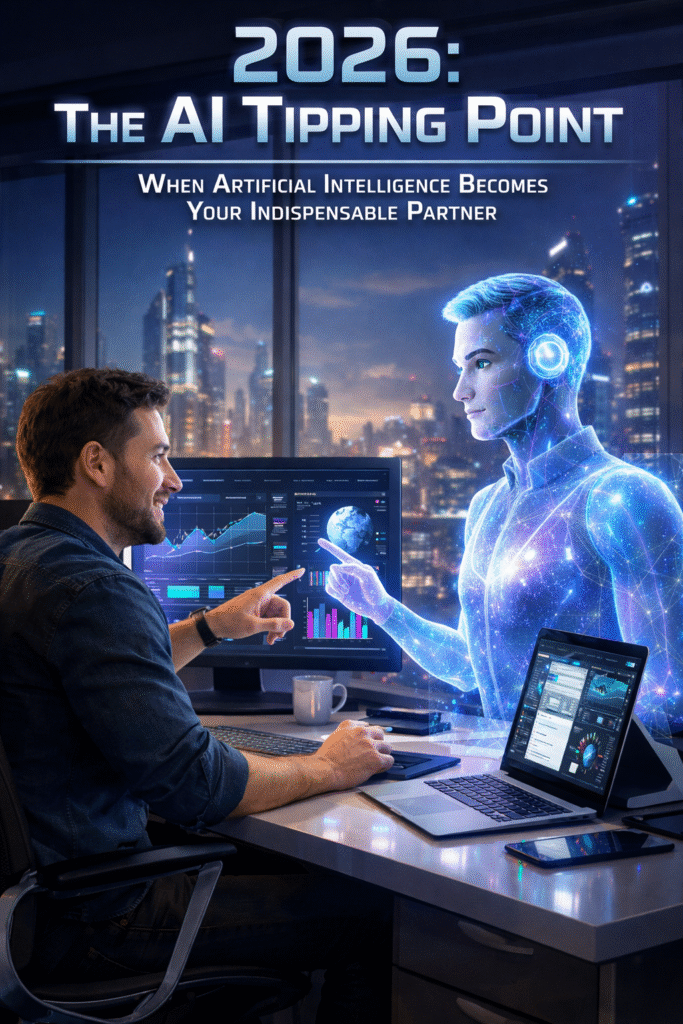
The Silent Revolution in Your Pocket
Imagine waking up on a crisp morning in January 2026. Before you even open your eyes, your AI has already analyzed your sleep patterns, pre-adjusted your home’s temperature, and started brewing coffee optimized for your cortisol levels. It’s reviewed your schedule, rescheduled a conflicting meeting, and drafted three critical emails in your authentic voice. This isn’t science fiction—this is 2026’s everyday reality.
We stand at the precipice of what experts are calling “The Practical Intelligence Revolution.” The flashy, speculative AI of the early 2020s is giving way to something more profound: seamless, reliable, and deeply integrated intelligence that works alongside humanity, not as a novelty, but as a fundamental utility.
Five Groundbreaking AI Advancements Defining 2026
1. The Era of Proactive Personalization
By 2026, AI evolves from being reactive to proactively predictive. Your digital assistant no longer waits for commands. It anticipates needs based on contextual awareness, biometric data, and behavioral patterns.
What this looks like: Your AI knows you’re likely to catch the flu based on exposure data, local outbreaks, and subtle physiological changes detected through your wearable. It proactively orders remedies, adjusts your work schedule, and alerts your doctor—all before symptoms appear.
2. “Zero-Interface” Computing
The biggest interface breakthrough isn’t a new screen—it’s no screen at all. Voice, gesture, and eventually neural interfaces become primary interaction modes.
What this looks like: You’re cooking dinner. Instead of searching recipes, you ask questions naturally. The AI not only guides you through steps but adjusts instructions based on your real-time progress, detected through ambient sensors. It notices you’re struggling with a technique and projects a holographic demonstration onto your countertop.
3. AI as Co-Creator in Every Profession
The “co-pilot” metaphor becomes literal. Every professional discipline receives tailored AI partners trained on specialized knowledge.
What this looks like: Architects collaborate with AI that generates structural designs meeting exact specifications while optimizing for sustainability. Journalists work alongside AI that researches, fact-checks in real-time, and even suggests narrative angles based on audience engagement predictions. Teachers receive AI assistants that customize lesson plans for each student’s learning style, detected through engagement metrics.
4. The Healthcare Transformation
AI achieves diagnostic accuracy surpassing human specialists in most medical imaging by 2026, but the real revolution is preventive, continuous care.
What this looks like: Your bathroom mirror runs daily non-invasive health scans, detecting micronutrient deficiencies or early biomarkers for chronic conditions. Your AI health coach adjusts your diet, supplements, and exercise in real-time, with all data seamlessly shared with healthcare providers.
5. Environmental Intelligence Networks
Climate tech converges with AI in unprecedented ways, creating what scientists call “Planetary Nervous Systems.”
What this looks like: Millions of AI-powered sensors monitor forests, oceans, and urban areas. Predictive models don’t just forecast weather—they simulate complex interventions. AI manages smart grids that balance renewable energy with precision, reducing waste by up to 40%. Agricultural AI optimizes crop yields while restoring soil health.
The Surprising Shift: AI Gets Smaller and More Personal
Contrary to predictions of ever-larger models, 2026 sees the rise of specialized compact AIs. Instead of one gargantuan model trying to do everything, we’ll have thousands of optimized AIs working in concert.
Your devices will run local AI that knows you intimately without constantly phoning home to the cloud. Privacy and personalization cease to be trade-offs. Your phone’s AI learns your habits, preferences, and quirks—all processed locally, all under your control.
The Human-AI Collaboration Economy
The most significant development won’t be technical—it’ll be cultural. 2026 marks when society fully embraces augmented intelligence rather than artificial replacement.
New job categories emerge: AI Trainers, Integration Specialists, and Ethics Auditors. The most valuable skill becomes collaborative intelligence—the ability to work synergistically with AI systems, guiding them with human judgment, creativity, and ethical reasoning.
The Challenges We Must Navigate
This future brings profound questions:
- How do we maintain human connection in an AI-mediated world?
- What happens when AI knows us better than we know ourselves?
- How do we prevent the “AI divide” between those who can leverage these tools and those left behind?
The companies and societies thriving in 2026 will be those addressing these questions today, establishing frameworks for ethical AI, continuous learning systems, and inclusive access.
Your 2026 Reality: Prepared or Left Behind?
The difference between leveraging AI and being disrupted by it will come down to one factor: adaptability. Those who learn to partner with AI as co-thinkers, co-creators, and co-learners will unlock unprecedented potential. Those who resist will find themselves increasingly isolated from a world transformed.
The most exciting development? AI in 2026 makes expertise more accessible, creativity more democratic, and problem-solving more collaborative. The surgeon in a remote village accesses the same diagnostic intelligence as specialists at elite hospitals. The small business owner optimizes operations with tools once available only to corporations.
The Ultimate Prediction: AI Becomes Invisible
The most accurate prediction for 2026 is that we’ll stop talking about “AI” as something separate. Like electricity or the internet, it becomes so woven into our lives that we only notice its absence. The technology fades into the background, while human potential moves to the foreground.
The question for 2026 isn’t “What can AI do?” but rather “What can humanity achieve with AI as our partner?” We’re not heading toward a robotic future, but toward a more profoundly human one—amplified, augmented, and empowered by intelligence that understands our world and our needs better than ever before.
The future isn’t artificial. It’s intelligently human.
*Start your adaptation journey today. The AI of 2026 is already being shaped by the conversations, investments, and ethical frameworks we’re establishing now. Your partnership with tomorrow’s intelligence begins with your next curious question, your next creative collaboration, your next decision to engage rather than observe. The future is co-created—what role will you play?
Leave a Reply